
School services
Build a better school. Strengthen your systems. Improve learning.
Arkademy SchoolHouse partners with school owners, proprietors, administrators and leadership teams to improve school operations, strengthen teaching and learning, adopt appropriate educational technology and build systems that support sustainable growth.
Whether you are establishing a new school, improving an existing one or preparing your school for a more digital future, we help you identify what needs to change and develop a practical plan to make it happen.
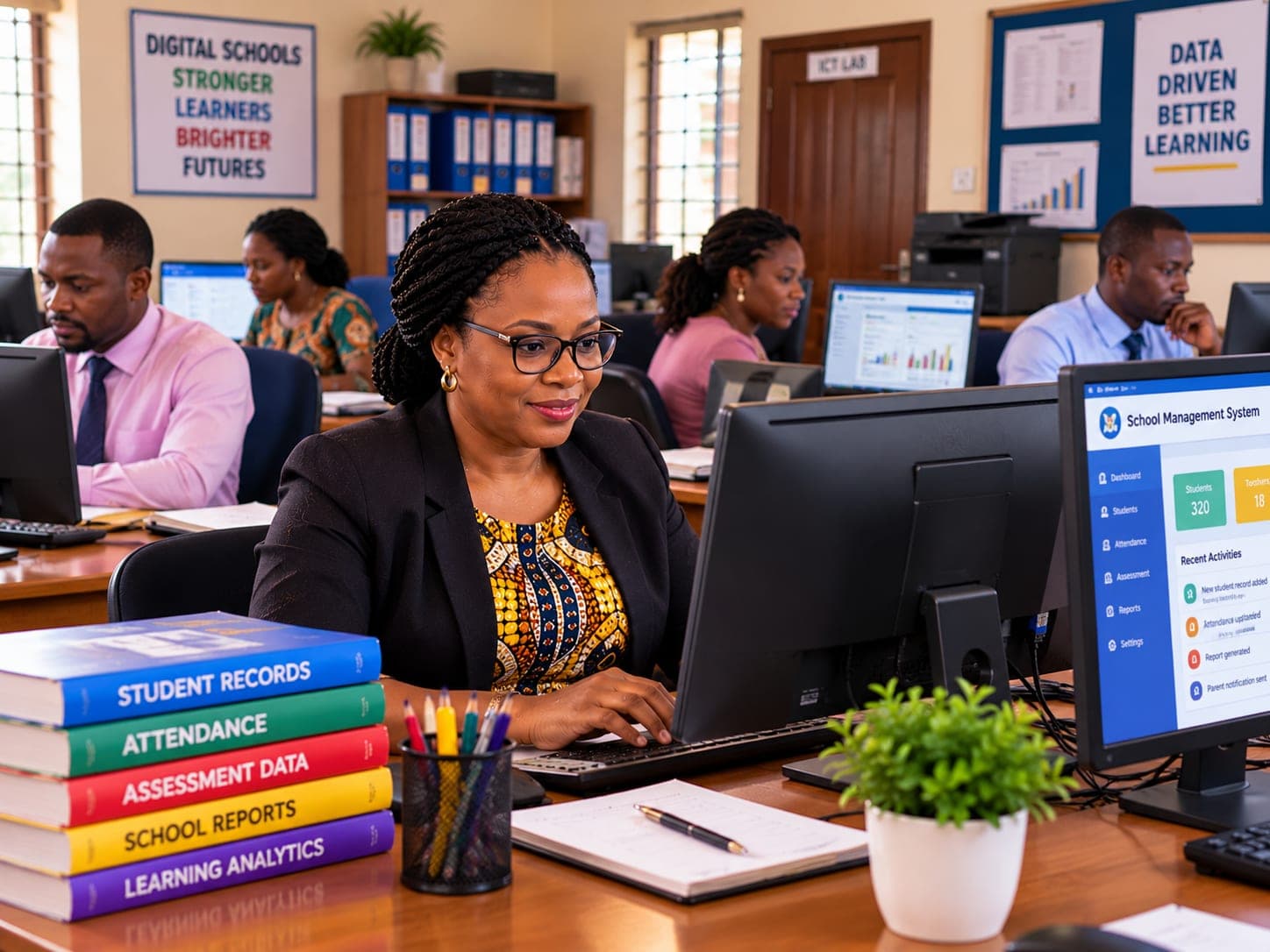
A better school is built not only on what happens in the classroom, but also on the systems, people, leadership and decisions that make effective learning possible.
Helping schools move from daily challenges to intentional improvement
Running a school requires much more than delivering lessons. School leaders must manage staff, support teachers, communicate with parents, monitor learners, maintain records, coordinate operations and make decisions that affect educational outcomes.
When systems are inefficient, teachers may spend too much time on administrative work. Important information may be difficult to retrieve. Parents may receive inconsistent communication. School leaders may struggle to see what is working and what requires attention.
Technology alone cannot solve every school challenge. Schools also need clear processes, capable people, appropriate policies and a culture of continuous improvement.
At Arkademy SchoolHouse, we help schools assess their current practices, identify priorities and implement practical improvements that fit their context, capacity and budget.
Our approach combines educational thinking, operational improvement, digital tools and people development. We aim to help schools work more effectively while keeping the learner at the centre of every decision.
Our guiding principle
School improvement should produce meaningful benefits for learners, teachers, parents and school leaders—not simply introduce more systems or technology.
Our school service areas
- 1.School digitalisation
- 2.School operations and systems improvement
- 3.Teaching and learning improvement
- 4.School technology and EdTech advisory
- 5.Staff capability and leadership development
Service 1
School digitalisation
For schools ready to reduce manual processes and use technology more effectively.
Many schools still rely heavily on paper records, spreadsheets, messaging applications and disconnected tools. Others have purchased digital systems but use only a small portion of their capabilities.
We help schools understand where technology can make a practical difference and develop a suitable digitalisation plan.
Our support may include:
- Reviewing existing administrative and academic processes.
- Identifying repetitive tasks that could be simplified or automated.
- Assessing school management systems and digital learning tools.
- Improving the organisation of student, staff and academic records.
- Exploring digital attendance, assessment and reporting workflows.
- Improving parent communication and information-sharing processes.
- Reviewing technology requirements, implementation costs and staff readiness.
- Planning implementation, staff orientation and adoption.
- Establishing a phased roadmap rather than changing everything at once.
- Our approach
- We start with your school's needs, not with a software product we want you to buy.
- Best suited to
- Schools seeking to modernise their operations, reduce avoidable administrative work, improve information management or make better use of educational technology.
Service 2
School operations and systems improvement
For school leaders who want more organised, consistent and accountable operations.
A school can have committed staff and capable teachers yet still struggle when responsibilities are unclear, processes are inconsistent or management depends on the constant intervention of the proprietor.
We help school leaders examine how the school operates and identify opportunities to create clearer, more sustainable systems.
Depending on the agreed scope, this may include:
- Reviewing key administrative and academic workflows.
- Clarifying staff responsibilities and reporting lines.
- Improving routine planning and coordination.
- Developing or refining standard operating procedures.
- Establishing practical systems for task follow-up and accountability.
- Reviewing how information moves between management, teachers and parents.
- Identifying operational bottlenecks and unnecessary duplication.
- Defining indicators that help leadership monitor implementation and progress.
- Creating an improvement action plan with priorities and timelines.
- Our approach
- Build systems that help people perform consistently instead of relying entirely on individual memory, repeated instructions or constant supervision.
- Best suited to
- Proprietors, school heads and administrators who want greater operational clarity, stronger coordination and more reliable processes.
Service 3
Teaching and learning improvement
For schools that want to strengthen the quality and consistency of classroom learning.
School improvement must ultimately benefit learners. Effective administration matters, but it should support—not distract from—the quality of teaching and learning.
Arkademy promotes intentional, learner-centred education that develops understanding, academic competence, creativity, critical thinking, practical skills and character.
Depending on the engagement, support may include:
- Reviewing existing teaching and learning practices.
- Helping school leaders identify priorities for instructional improvement.
- Exploring learner-centred and activity-based teaching approaches.
- Encouraging meaningful assessment and feedback.
- Identifying opportunities to strengthen foundational literacy, numeracy and reasoning.
- Exploring appropriate ways to integrate digital resources into learning.
- Supporting school leaders in planning classroom observation and teacher feedback processes.
- Helping schools develop practical improvement goals for teaching and learning.
- Our approach
- Focus on what learners understand, can do and are becoming—not only what has been covered in a lesson or recorded in a result sheet.
- Best suited to
- Schools seeking to improve instructional practice, learner engagement, assessment processes and the overall learning experience.
Service 4
School technology and EdTech advisory
For schools that need help choosing the right technology before investing in it.
The education technology market offers many platforms, applications and digital resources. Choosing the wrong system can create unnecessary costs, staff frustration and poor adoption.
We help schools think through their actual requirements before committing to tools or technology projects.
Our advisory support may include:
- Defining the problem a technology solution should address.
- Identifying functional and operational requirements.
- Comparing suitable software categories and available options.
- Considering usability, cost, training, support and implementation needs.
- Reviewing data privacy, access controls and information security considerations.
- Assessing whether existing tools can be improved before new tools are purchased.
- Planning pilot projects and staged implementation.
- Developing staff orientation and adoption plans.
- Considering responsible use of AI in school administration and learning.
Where a school needs a particular software product or technical implementation, we will clarify whether Arkademy can provide the work directly or whether an external provider is required.
- Our approach
- Choose technology because it solves a defined problem, not because it is fashionable.
- Best suited to
- Schools considering a new management system, digital learning platform, AI tool or wider technology upgrade.
Service 5
Staff capability and leadership development
For schools that want their people to grow alongside their systems.
New policies, software and processes only work when the people responsible for implementing them understand their roles and have the skills to carry them out.
Arkademy supports the development of school leaders, teachers and other staff through relevant professional learning and implementation guidance.
Depending on the school's needs, this may include:
- Leadership and school management development.
- Staff role clarity and accountability.
- Effective use of educational technology.
- Practical approaches to teaching and learning.
- Communication and collaboration.
- Change management and staff adoption of new systems.
- Planning and reviewing staff development priorities.
- Building a culture of reflection and continuous improvement.
Some engagements may be delivered through workshops, while others may involve coaching, consultancy or structured training programmes.
- Our approach
- Strengthen the people who make the school work, not just the processes they are expected to follow.
- Best suited to
- Schools preparing for growth, implementing new systems, strengthening leadership or investing in staff development.
Our school engagement process
We believe school improvement should begin with understanding the school—not selling a predetermined package.
Our engagement process is designed to help your leadership team identify the right priorities and move towards implementation in manageable stages.
Step 1: Initial consultation
We begin with a conversation about your school, its current challenges and what you want to improve.
We may discuss your school's size and structure, current systems, staffing arrangements, use of technology, communication practices and immediate priorities.
Outcome: An initial understanding of the school's needs and the appropriate next step.
Step 2: School needs assessment
Where the scope requires it, we review the relevant processes, systems and practices that influence the challenge you have identified.
This may involve discussions with school leadership, process walkthroughs, review of selected documents, staff feedback or an examination of existing digital tools. Any access to school or learner information should be agreed in advance and handled appropriately.
We aim to distinguish the underlying problem from its visible symptoms.
For example, delayed reports may reflect a manual workflow, unclear responsibilities, fragmented information or insufficient staff training. Each problem requires a different response.
Outcome: A clearer picture of the challenges, their likely causes and the areas requiring attention.
Step 3: Agree on priorities and success measures
Not every problem needs to be solved at once. We help the school identify which improvements are most important, feasible and valuable.
Together, we define the desired results and practical indicators for monitoring progress.
These may include process completion time, record accuracy, staff adoption, parent communication consistency, reporting timeliness or agreed teaching and learning priorities.
Outcome: An agreed set of priorities and a clear understanding of what improvement should look like.
Step 4: Develop a school improvement plan
We prepare recommendations aligned with the school's context, resources and objectives.
Depending on the engagement, the plan may cover process redesign, software selection, staff training, policy or procedure development, digitalisation priorities and implementation sequencing.
We distinguish immediate improvements from longer-term projects and identify dependencies, responsibilities and likely costs where these can be established.
Outcome: A practical roadmap with agreed actions, priorities and responsibilities.
Step 5: Implement the agreed solutions
Implementation depends on the service selected. It may involve refining existing processes, introducing a suitable digital tool, documenting procedures, training staff or coordinating with an external technical provider.
We encourage a phased approach, starting with a manageable area where the school can test the new approach and learn before expanding it.
Outcome: The agreed changes are put into practice in a controlled and understandable way.
Step 6: Support staff adoption
A system is not successful simply because it has been installed or a workshop has been completed. Staff must understand how the new approach fits into their daily work.
Where included in the engagement, we provide orientation, training, guidance materials or follow-up support to help staff apply the agreed processes.
We also encourage school leaders to communicate the purpose of the changes, clarify expectations and provide a way for staff to raise implementation challenges.
Outcome: Staff have a clearer understanding of the new processes and how to use them.
Step 7: Review progress and refine
After implementation, we review the agreed indicators and gather feedback on what is working and what still needs attention.
The school may need to adjust its processes, provide additional staff support, refine a tool or revise the implementation plan.
Outcome: An informed view of progress and practical next steps for continued improvement.
Step 8: Plan for sustainability
The long-term goal is to help the school maintain and improve its systems beyond the initial engagement.
We encourage clear ownership of processes, accessible documentation, appropriate staff training and periodic reviews so that improvements do not depend entirely on an external consultant.
Outcome: A school improvement approach that can be sustained and developed over time.
What can your school receive?
Deliverables depend on the service and scope agreed. A school engagement may include one or more of the following:
- A school needs assessment or findings summary.
- A prioritised school improvement roadmap.
- A digitalisation strategy.
- Software or EdTech selection recommendations.
- A review of selected school processes.
- Documented procedures and staff responsibilities.
- A technology implementation plan.
- Staff orientation or professional development.
- Practical guidance materials and checklists.
- Agreed indicators for tracking implementation.
- Follow-up consultations or progress reviews.
Before work begins, we clarify the deliverables, responsibilities, timelines, fees and any third-party costs.
We do not assume that every school needs every service. The aim is to provide the level of support that matches your school's actual needs.
Who we work with
School proprietors and owners
For leaders seeking to strengthen the school's operational foundation, improve oversight and prepare for sustainable growth.
Principals and school heads
For leaders coordinating staff, teaching, administration and parent relationships who need clearer systems and more consistent implementation.
School administrators and bursars
For teams seeking to improve administrative workflows, information management, reporting and the use of suitable digital tools.
Academic coordinators and heads of department
For leaders responsible for curriculum delivery, teaching practice, assessment and professional support for teachers.
Schools planning a digital transformation
For schools that want to move beyond scattered digital tools towards a coherent, secure and manageable technology approach.
New and growing schools
For schools that need to establish sound processes early, identify appropriate technology and build a foundation for future improvement.
Why Arkademy SchoolHouse?
Education comes first
We evaluate school systems and technology in relation to their contribution to learning, staff effectiveness, communication and school operations.
Practical solutions over unnecessary complexity
We encourage schools to solve their most important problems first. A well-designed process and a simple tool can sometimes be more useful than a complex platform that staff cannot maintain.
People and systems work together
We recognise that successful implementation requires leadership, clear responsibilities, appropriate training and staff participation.
Technology with purpose
We support the thoughtful use of educational technology and AI while recognising the importance of human judgement, child safeguarding, privacy and responsible implementation.
Improvement that fits your context
Schools differ in size, resources, location, leadership structure and level of digital readiness. We work towards recommendations that reflect those realities rather than assume every school should follow the same model.
A commitment to intentional learning
Our wider educational philosophy emphasises academic excellence, godly character, creativity, critical thinking, practical competence and the development of Africa's future thinkers.
Frequently asked questions
What does Arkademy mean by school digitalisation?
School digitalisation means using appropriate digital tools and improved processes to make school operations, communication, record management and learning support more effective. It is not simply buying software. It includes understanding the school's needs, selecting suitable tools, preparing staff and reviewing whether the changes are useful.
Does Arkademy provide school management software?
Our role is to help schools identify their needs and determine suitable options. Depending on the project, we may provide advisory support, assist with implementation or work with a relevant technology provider. The availability of a particular software product or direct implementation service should be confirmed during consultation.
Can you help a school that still uses mostly paper records?
Yes. We can help assess existing processes and identify which records and workflows may benefit from improved organisation or digitalisation. The transition should take account of staff capacity, costs, data security, existing records and the need to keep essential operations running during implementation.
Our school already uses digital tools. Can you still help?
Yes. Digitalisation is not always about adding another platform. We can help examine whether existing tools are being used effectively, whether information is fragmented across systems, and whether staff need clearer processes or additional training.
Can you help us choose the right school management system?
We can help define your requirements, compare suitable options and consider functionality, usability, costs, staff readiness, data handling, support and implementation needs. The final choice should be based on the school's priorities and a clear understanding of the provider's capabilities and terms.
Do you build custom software for schools?
Custom software development is a separate technical requirement that must be assessed against the school's needs, budget, integration requirements and long-term maintenance capacity. During consultation, we will clarify whether custom development is within the agreed scope or whether a suitable existing product or external technical provider is more appropriate.
Can you help us improve staff accountability?
We can help school leadership review role clarity, reporting lines, processes, expectations and follow-up mechanisms. Effective accountability should be clear, fair and supported by appropriate training and resources. It should not depend only on surveillance or punishment.
Do you provide teacher training?
Arkademy offers a wider focus on teacher, staff and leadership development. The specific training topics, format and availability depend on the programme agreed. Please see our Teacher and Leadership Training service page for more information.
Can you help improve teaching and learning outcomes?
We can help schools identify areas for instructional improvement and plan relevant changes to teaching practices, assessment, staff development and the use of learning resources. Actual outcomes depend on implementation, learner needs, school conditions and other factors; we do not guarantee particular academic results.
Do you work with nurseries, primary schools and secondary schools?
The appropriate service depends on the school's needs and the scope of work. Contact us with your school's level, location and priorities so we can establish whether the requested support is a suitable fit.
Do you work only with schools in Ibadan?
The geographic scope depends on the service. Some consultancy and advisory work may be suitable for virtual delivery, while assessments, training or implementation may require in-person engagement. Confirm the available delivery arrangements when making an enquiry.
How long does a school digitalisation or improvement project take?
There is no universal timeframe. A focused consultation or process review may be relatively short, while implementing a new system across a school may require considerably more preparation, training and follow-up. We will propose a realistic timeline after understanding the scope and dependencies.
How much do your school services cost?
Fees depend on the scope, complexity, delivery format and level of support required. A consultation, a school assessment, a digitalisation roadmap, staff training and a multi-stage implementation project may have different costs. We will clarify the proposed work and applicable fees before you commit.
Will you train our staff to use new systems?
Staff orientation and training can be included where agreed. The training approach should reflect staff roles, technology familiarity, the complexity of the system and the support available after implementation.
How do you handle student and staff information?
School data should be accessed only where necessary, with appropriate authorisation and safeguards. Before any assessment or implementation involving personal information, the parties should agree on access, responsibilities, security, retention and any relevant privacy requirements. Schools should not share unnecessary identifiable learner information during an initial enquiry.
Do you guarantee that digitalisation will reduce costs or improve performance?
No. The impact depends on the school's starting point, the suitability of the chosen solution, implementation quality, staff adoption and ongoing costs. We help schools define expected benefits, assess trade-offs and monitor agreed indicators rather than promise outcomes that cannot be guaranteed.
What if our school has a limited budget?
We can help prioritise the most important needs and consider phased improvements. This may involve refining existing processes, improving how current tools are used or addressing one high-impact workflow before investing in a larger system. The aim is to match the solution to the school's capacity and priorities.
What should we prepare before contacting Arkademy?
You do not need a complete project plan. It is helpful to know your school's type and location, the main challenges you want to address, the tools or processes you currently use and the outcome you hope to achieve. We can help you identify the remaining questions during the consultation.
Let's build a stronger school together
Your school does not need to change everything at once. The right starting point is to understand what is holding your team back, identify the improvements that matter most and build a plan that can be implemented realistically.
Whether you want to improve school operations, strengthen teaching and learning, introduce appropriate technology or develop your staff, Arkademy SchoolHouse can help you take a more intentional approach.
Let's build school systems that support teachers, serve families and create better learning experiences for children.
Arkademy SchoolHouse Ltd — Raising Africa's Future Thinkers